
Installing a fence seems straightforward until you realize you’re not entirely sure where your property ends and your neighbor’s begins. That uncertainty can turn a simple weekend project into a costly legal dispute. Knowing your exact property lines before a single post goes into the ground is one of the smartest moves any homeowner can make.
Property boundaries aren’t always obvious. Overgrown vegetation, missing markers, and informal agreements between previous owners can all muddy the picture. Whether you’re putting up a privacy fence, a decorative picket, or a security barrier, the process starts the same way — with accurate, verified property lines.
This guide walks you through every practical method for finding your property lines, from free online tools to hiring a licensed surveyor. You’ll also find answers to the most common questions homeowners ask before starting a fence installation project.
Why Locating Property Lines is Essential Before Installing a Fence
Skipping this step is one of the most common and expensive mistakes homeowners make. A fence built even a few inches over the line can trigger legal action, force removal, and damage relationships with neighbors that took years to build.
Legal and Practical Risks of Incorrect Boundaries
Encroachment is a real legal issue. If your fence crosses onto a neighbor’s land, they have the right to demand removal at your expense. Courts consistently side with documented property surveys over informal assumptions.
Beyond neighbor disputes, there are other serious risks to consider. Easements and right of way corridors may run along your property edge, and placing a fence across them can violate utility agreements or municipal codes. Zoning laws and setback requirements also dictate how close a fence can be to the property line, the road, or existing structures.
| Risk Type | Potential Consequence | Prevention Method |
|---|---|---|
| Encroachment | Forced fence removal | Professional land survey |
| Easement violation | Legal penalties, utility conflicts | Review deed and title records |
| Setback violation | Building permit denial or fines | Check local zoning laws |
| HOA non-compliance | Fines, mandatory removal | Review HOA guidelines first |
Getting your boundaries right protects your investment and your relationships. A homeowners association may also have specific rules about fence placement, materials, and height that go beyond local zoning laws. Ignoring these can result in fines or mandatory removal even if your fence is technically on your own land.
Step-by-Step Methods to Find Your Property Lines
There’s no single method that works perfectly in every situation. Most homeowners benefit from using two or three approaches together to confirm accuracy before committing to a fence layout.
Check Online Tools and Maps
GIS maps, or Geographic Information System maps, are available through most county and municipal websites at no cost. These property maps display parcel boundaries overlaid on aerial imagery, giving you a visual starting point for understanding your lot shape and approximate property lines.
Online property records through county assessor portals often include parcel dimensions and boundary descriptions. GPS technology built into some of these platforms lets you view your location relative to mapped boundaries in real time.
Keep in mind that online tools are useful for orientation, not precision. GIS maps can have measurement errors of several feet, which matters a great deal when you’re placing fence posts. Use them to get a general picture, then verify with more reliable methods.
Review Deeds, Plat Maps, and County Records
Your property deed contains a legal description of your land. This description uses metes and bounds language or lot and block references tied to a recorded survey plat. Reading it carefully can reveal the exact dimensions and angles of your property boundaries.
A survey plat is a scaled drawing of your lot created during the original subdivision of the land. You can usually obtain a copy from your county recorder’s office, title company, or through online property records portals. The plat shows boundary lines, dimensions, easements, and sometimes the location of original survey stakes.
If you purchased your home recently, your title company may have provided a property survey or boundary sketch at closing. Check your closing documents before spending money on new research.
Search for Physical Markers and Pins
Survey stakes and boundary markers are often placed at property corners during a land survey. These are typically iron rods or pipes driven into the ground, sometimes topped with a plastic cap stamped with the surveyor’s information.
Finding them isn’t always easy. They can be buried under soil, covered by grass, or displaced over time. A metal detector is one of the most effective tools for locating buried iron survey pins. Walk the perimeter of your lot slowly, focusing on corners and areas where boundary lines should intersect.
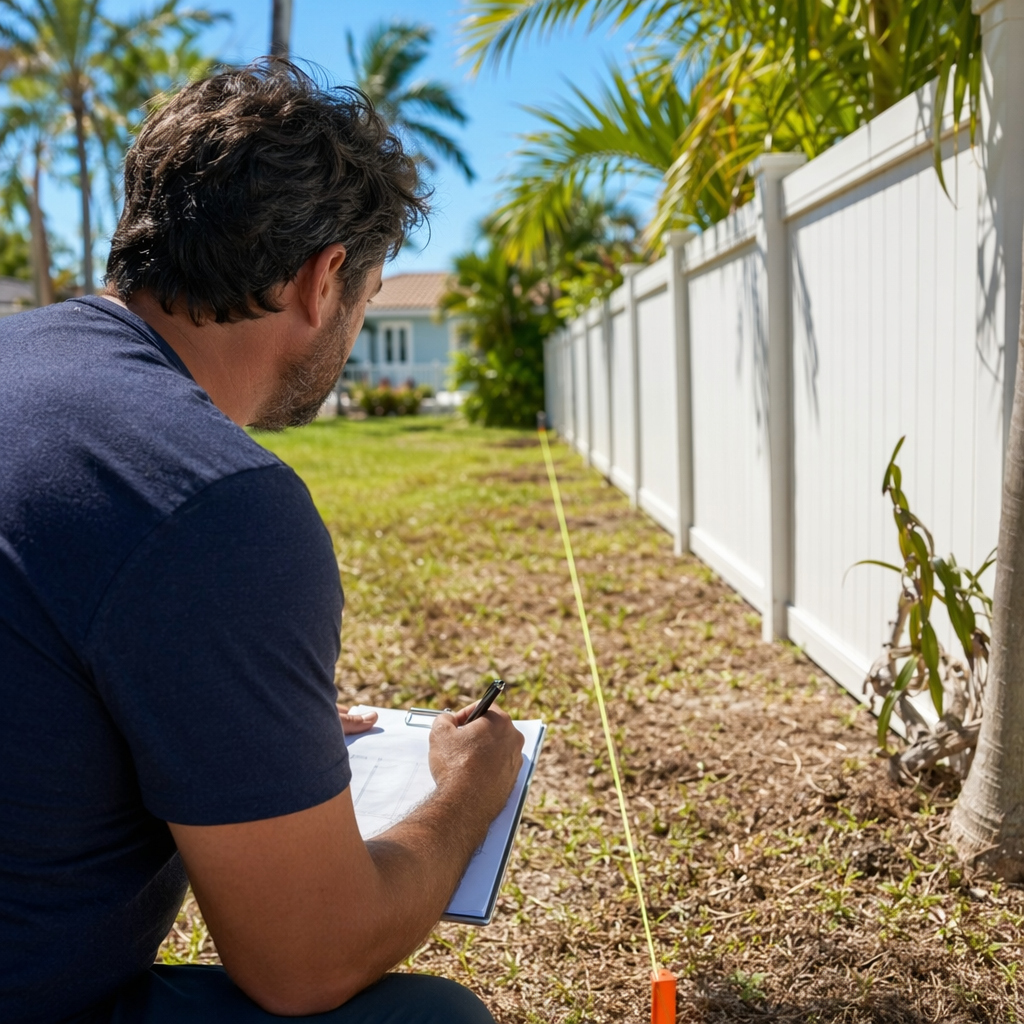
Once you locate a pin, mark it with a visible flag or stake so you can reference it during fence planning. Finding two or more pins allows you to establish a line between them with a string or laser level.
Hire a Professional Surveyor
A licensed surveyor provides the most accurate and legally defensible method for establishing property boundaries. They use GPS technology, historical records, and precision instruments to locate and confirm your property lines on the ground.
A property survey results in a formal document and physical markers that you can rely on for fence installation, legal disputes, or future property transactions. If you’re planning a significant fence project, this investment pays for itself quickly. Before you prepare your yard for fence installation, having a surveyor confirm your boundaries removes all guesswork from the process.
Practical Applications for Fence Installation
Once you know where your property lines are, the next step is translating that information into a practical fence layout. This is where preparation meets execution.
Using Found Lines to Plan and Stake Your Fence
Start by marking all confirmed boundary corners with visible stakes or flags. Run a string line between them to establish a straight reference line for your fence. This string becomes your guide for post placement and alignment.
Most homeowners choose to install their fence slightly inside the property line — typically two to six inches — to avoid any risk of accidental encroachment. This small buffer also makes maintenance easier since you can access both sides of the fence without stepping onto a neighbor’s property.
Check your local setback requirements before finalizing placement. Some municipalities require fences to sit a specific distance from the road, sidewalk, or adjacent structures regardless of where the property line falls. A building permit application will often trigger a review of these requirements, so apply early in your planning process.
Understanding what a fence project actually costs helps you budget accurately once your layout is confirmed and you know the total linear footage involved.
Call 811 Before Digging
Calling 811 is a legal requirement in most states before any digging project. This free service dispatches utility locators to mark underground lines including gas, electric, water, and telecommunications on your property.
Utility lines don’t always follow logical paths. A line might run diagonally across your yard or closer to the surface than expected. Hitting one during fence post installation can cause serious injury, service outages, and significant repair costs.
Call at least a few business days before your planned dig date. Locators will mark the ground with color-coded flags or paint indicating the type and approximate location of each utility. Plan your post locations around these markings.
Common Questions and Troubleshooting
Even with careful preparation, homeowners run into complications. Here are the most common issues and how to handle them.
What If I Can’t Find Survey Pins?
Missing or displaced boundary markers are more common than most people expect. Pins get knocked out by construction equipment, buried during landscaping, or simply corrode over decades. If your metal detector search comes up empty, don’t guess.
Your options include:
- Ordering a new property survey from a licensed surveyor
- Reviewing your survey plat for reference measurements from fixed structures
- Contacting your county recorder’s office for historical survey records
- Checking with neighbors who may have had recent surveys done
Never assume a fence line, hedge, or wall marks the actual property boundary. These features are often placed informally and may not reflect legal property lines at all.
Disagreements with Neighbors on Boundaries
Neighbor disputes over property boundaries are among the most common sources of residential legal conflict. If you and your neighbor disagree about where the line falls, the only reliable resolution is a professional land survey.
Approach the conversation calmly and factually. Share your deed, plat map, and any survey results you have. Invite your neighbor to review the same documents. In many cases, a shared survey cost splits the expense and gives both parties confidence in the result.
If the disagreement escalates, consult a real estate attorney before installing anything. An encroachment claim or boundary dispute lawsuit is far more expensive than the cost of a survey or legal consultation upfront.
Cost Estimates for Surveys
Survey costs vary based on lot size, terrain, location, and the complexity of the legal description. A basic boundary survey for a standard residential lot typically runs between several hundred and a few thousand dollars.
Some factors that affect pricing include:
- Lot size and shape complexity
- Availability of existing survey records
- Local market rates for licensed surveyors
- Whether physical markers need to be set or reset
Knowing your fence layout in advance also helps you get accurate quotes from contractors. Understanding how long fence installation takes helps you coordinate the survey, permitting, and construction timeline efficiently.
Conclusion
Finding your property lines before installing a fence isn’t optional — it’s the foundation of a successful project. Skipping this step risks encroachment, legal disputes, permit denials, and wasted money on a fence that may need to be moved or removed entirely.
Use online GIS maps and county records as a starting point. Search for physical boundary markers with a metal detector. Review your deed and survey plat carefully. When accuracy matters most, hire a licensed surveyor to confirm everything on the ground.
A little preparation upfront saves significant time, money, and stress. Once your lines are confirmed, you can plan your fence layout with confidence and move forward knowing your project is built on solid legal ground. Choosing the right contractor matters just as much as knowing your boundaries — working with an experienced fence contractor ensures the installation matches your plans precisely.
FAQ
Is Google Maps Accurate for Property Lines?
Google Maps is not accurate enough for determining property lines. It uses satellite imagery that may be outdated and does not display legal parcel boundaries with the precision needed for fence installation. Use your county’s GIS maps or official property records instead, and always verify with physical markers or a professional survey before digging.
Do I Need a Survey for Every Fence Project?
Not always, but it depends on your situation. If you have a recent survey with clearly marked pins and no disputes with neighbors, you may be able to proceed using existing documentation. If pins are missing, boundaries are unclear, or your lot has an unusual shape, a new property survey is strongly recommended before any fence installation begins.
How Long Does Locating Property Lines Take?
Using online tools and reviewing existing records can take a few hours to a couple of days. Searching for physical survey pins with a metal detector typically takes an afternoon. Hiring a licensed surveyor usually requires scheduling in advance, and the survey itself may take one to several days depending on lot complexity and surveyor availability. Plan accordingly so boundary confirmation doesn’t delay your fence project timeline.